
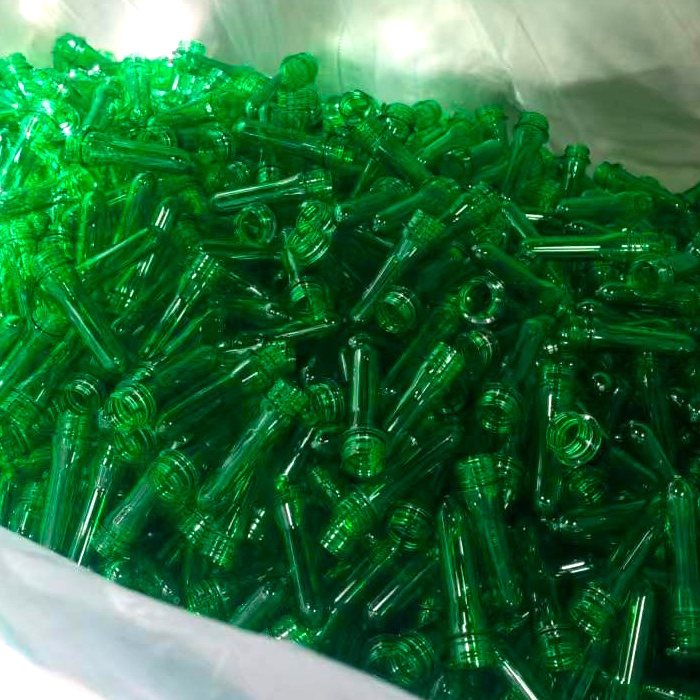
Bottle Preform (PET Preform)
Commonly known as a "tube blank" or "bottle tube," this is a semi-finished product made from PET (polyethylene terephthalate) resin chips via injection molding. It is subsequently fed into a blow molding machine, where it undergoes heating and biaxial stretching using high-pressure air to be blown into a finished PET bottle (e.g., for mineral water, carbonated drinks, beverages, or cooking oil).
Industry Value Chain:
PET Chips → Injection Molding Machine → PET Preform → Blow Molding Machine → Empty PET Bottle → Filling (Cola / Water / Juice)
1. Industry Application Scenarios
Carbonated Soft Drink Bottles
Cola, Sprite; typically uses the PCO1881 neck finish; preforms feature a high-pressure-resistant formulation to prevent bursting.
Bottled Still Water and Mineral Water
PCO1810 neck finish; continuous lightweighting (weight reduction).
Juice, Tea, and Hot-Fill Beverages
Heat-resistant PET preforms (heat-set formulation).
2. Core Raw Material: PET Resin
Two main categories:
Bottle-Grade PET Chips
Intrinsic Viscosity (IV): 0.78–0.86 dl/g (standard range for drinking water and carbonated drinks).
Carbonated soft drink bottles require higher IV and lower acetaldehyde (AA) content.
Additives
Color Masterbatch: For transparent, blue, green, or milky-white preforms.
Barrier Masterbatch: Enhances oxygen barrier properties for juice and hot-fill bottles.
Bottle Preform (PET Preform)
Commonly known as a "tube blank" or "bottle tube," this is a semi-finished product made from PET (polyethylene terephthalate) resin chips via injection molding. It is subsequently fed into a blow molding machine, where it undergoes heating and biaxial stretching using high-pressure air to be blown into a finished PET bottle (e.g., for mineral water, carbonated drinks, beverages, or cooking oil).
Industry Value Chain:
PET Chips → Injection Molding Machine → PET Preform → Blow Molding Machine → Empty PET Bottle → Filling (Cola / Water / Juice)
1. Industry Application Scenarios
Carbonated Soft Drink Bottles
Cola, Sprite; typically uses the PCO1881 neck finish; preforms feature a high-pressure-resistant formulation to prevent bursting.
Bottled Still Water and Mineral Water
PCO1810 neck finish; continuous lightweighting (weight reduction).
Juice, Tea, and Hot-Fill Beverages
Heat-resistant PET preforms (heat-set formulation).
2. Core Raw Material: PET Resin
Two main categories:
Bottle-Grade PET Chips
Intrinsic Viscosity (IV): 0.78–0.86 dl/g (standard range for drinking water and carbonated drinks).
Carbonated soft drink bottles require higher IV and lower acetaldehyde (AA) content.
Additives
Color Masterbatch: For transparent, blue, green, or milky-white preforms.
Barrier Masterbatch: Enhances oxygen barrier properties for juice and hot-fill bottles.
Bottle Preform (PET Preform)
Commonly known as a "tube blank" or "bottle blank." It is a semi-finished product made from PET (polyethylene terephthalate) resin chips via injection molding. It is subsequently fed into a blow molding machine, where it undergoes heating and biaxial stretching using high-pressure air to be blown into a finished PET bottle (e.g., for mineral water, carbonated drinks, beverages, or cooking oil).
Industry Chain Sequence:
PET Chips → Injection Molding Machine → PET Preform → Blow Molding Machine → Empty PET Bottle → Filling (Cola / Water / Juice)
1. Structural Components
Neck (Critical standardized area)
Neck finish: Threading standard (Industry-standard types: PCO 1810, PCO 1881, 30/25, 29/25, 28mm, 38mm, etc.)
Support ring / Shoulder ring: A key feature for clamping/positioning in the blow molding machine and for engagement with conveyor tracks.
Thread: Matches the bottle cap.
Body (Tubular main section)
Stretching zone; determines the thickness distribution of the bottle sidewalls.
Tail / Gate (Bottom)
Injection point; types include center gate and side gate. High-speed blow molding lines prefer flat gates to avoid uneven heating.
2. Core Raw Material: PET Resin
Two main categories:
Bottle-grade PET chips
IV (Intrinsic Viscosity): 0.78–0.86 dl/g (Standard range for drinking water and carbonated beverages)
Carbonated beverage bottles require higher IV and lower acetaldehyde (AA) content.
Additives
Color masterbatch: For transparent, blue, green, or milky-white preforms.
Barrier masterbatch: Enhances oxygen barrier properties for juice and hot-fill bottles.
Recycled PET (rPET): Mandatory inclusion of a certain percentage of recycled material in European and American markets (policies of major beverage manufacturers in the EU and US).
Key Indicator: AA (Acetaldehyde)
High-temperature injection molding generates acetaldehyde; excessive levels can impart an off-flavor to drinking water. Coca-Cola and Pepsi enforce strict upper limits on AA (acetaldehyde) levels in preforms; meeting these standards is a prerequisite for securing high-end orders.
3. Key Parameter Specifications
Neck Standard (Most common types)
PCO 1881: Carbonated soft drinks (standard for Coke and other sodas; a key focus area)
PCO 1810: Mineral water, still water
28mm, 30/25, 38mm: Large-format water bottles, edible oil bottles
Weight (Gram Weight)
Examples: 12.8g, 14g, 16g, 18.5g, 22.5g, 25g, 32g
For a standard 500ml bottle, lightweighting preforms is a key cost-reduction strategy for major beverage manufacturers (the "lightweighting" trend).
Length (Total preform length), OD (Outer Diameter), ID (Inner Diameter)
Color
Natural (Clear) / Blue / Green / Amber / White (Light-blocking/Opaque)
IV (Intrinsic Viscosity), AA (Acetaldehyde content), Crystallinity, Dust/Fines content
High-speed blow molding lines demand extremely uniform crystallinity; whitening or localized crystallization can cause blowouts (punctures) during the blowing process.
4. Production Process: Injection Molding
Process Flow:
PET resin drying (Crucial step! PET is highly hygroscopic; excessive moisture leads to white haze or cracks during blowing) → Extrusion & Melting → High-pressure injection into preform mold → Cooling & Setting → Ejection → Inspection & Packaging
Equipment Brands: Krones (standard high-end injection molding machines for overseas Coke/Pepsi plants), Netstal; domestic brands include Tederic, Langge, Bole, etc.
Molds: Multi-cavity molds (48, 64, 72, 96, or 128 cavities); higher cavity counts result in higher production capacity.
5. Blow Molding Compatibility (Krones/Sidel Lines)
Two Production Modes
One-stage Process (Inline / One-stage)
Integrated injection and blow molding equipment; primarily used for small-to-medium bottle sizes; rarely used by large-scale beverage plants. Two-stage (or two-step) process
Preforms produced by a standalone injection molding machine → Packaging and transport → Bottles blown by a standalone blow molding machine
The mainstream model for global beverage plants
Centralized, large-scale preform production, with preforms shipped to filling plants equipped with dedicated blow molding workshops;
Blow molding equipment: High-speed machines such as Krones Contiform, Sidel, and Aoki.
Purchased preforms must be compatible with the blow molding machine: different blow molding oven heating profiles require specific preform wall thicknesses and crystallinity levels.
6. Industry application:
Carbonated Soft Drink (CSD) bottles;
Cola, Sprite; standard PCO1881 neck finish; preforms made with high-pressure-resistant formulations to prevent bursting;
Bottled still water and mineral water;
PCO1810 neck finish; continuous lightweighting (weight reduction);
Juice, tea, and hot-fill beverages;
Heat-resistant PET preforms (heat-set formulations).

Qingdao Huayingxin Packing Material Co.,Ltd.
No.12 Jinhuanghai Road,Daxin Town,Jimo District,Qingdao City,Shandong Province,China
Tel:0532-67722919
Fax:0532-67722919
E-mail:jack@hyxqd.com